

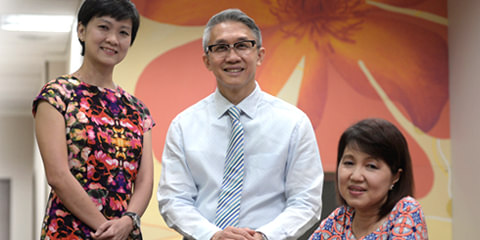
Our dermatologists at the Specialist Skin Clinic have more than 60 years of combined experience and specialise in the diagnosis and treatment of hair loss for both men and women.
Dr Cheong Wai Kwong, past President of the Dermatological Society of Singapore (2000 – 2005), is experienced with the use of various lasers and IPL for treating acne, acne scars, pigment problems such as freckles and age spots and removal of tattoos and birthmarks as well as Exilis® for non-invasive face lift. He was a member of the Asia Pacific guideline committee for androgenetic alopecia and has lectured on management of hair loss to doctors both locally and in the region.
Dr. Phay Ken-Lin is also an accredited Fellow of the Academy of Medicine, Chapter of Dermatologists. Her practice encompasses all aspects of general dermatology pertaining to children and adults. She is highly regarded in the field of cosmetic dermatology and has special interest in the treatment of acne and acne scars and pigment disorders.
Dr Neoh Ching Yin evaluates and treats all general medical and surgical conditions of the skin, mucous membrane, hair and nails in both adults and children. Her special interests include management of atopic eczema and medical dermatology that covers conditions such as psoriasis, lupus erythematosus, blistering skin diseases like pemphigus and pemphigoid and recurrent oral ulcers. In recent years, she has also developed a keen interest in the treatment and evaluation of hair loss.
Whether your hair loss is sudden or gradual, a hair loss consultation can help you understand the current condition of your hair and what you can do about it. You will have the opportunity to have your hair loss concerns and questions addressed by a dermatologist, who is an expert in hair loss management.
Your visit with the dermatologist should be a comfortable one and one that starts like a typical visit to your family physician. A trained dermatologist will examine your hair and scalp and provide comprehensive information about your hair loss and treatment options. Only when patients fully understand their condition and available treatment options will they be able to make a wise and unbiased decision about their treatment.
A dermatologist is a doctor who has undergone years of specialised medical and surgical training in the skin, hair and nails. He/she is the most qualified doctor to provide advice and treatment options for your hair loss problems.
Involutional alopecia is a natural condition in which the hair gradually thins with age. More hair follicles go into the resting phase, and the remaining hairs become shorter and fewer in number.
Androgenic alopecia is a genetic condition that can affect both men and women. It is a common form of progressive hair loss that affects up to 80% of men by age 80. Men with this condition, also called male pattern hair loss (MPHL), may begin suffering hair loss as early as their teens or early 20s. It's characterized by a receding hairline and gradual disappearance of hair from the crown and frontal scalp. Women with this condition, called female pattern hair loss, may also experience noticeable thinning when they are in their 30s or 40s. Women tend to experience thinning of hair in the frontal scalp without a receding hairline.
Alopecia areata often starts suddenly and causes patchy hair loss in children and young adults. This is due to an autoimmune process in the skin.
The basis of MPHL is the progressive decrease in terminal (thick and pigmented) hairs and an increase in vellus (short, fine and non pigmented). There is miniaturization of the hair follicles and a lengthening of the time between the telogen and anagen phase of the hair cycle resulting in a decrease in the number of hairs. The role of androgens, in particular, dihydrotestosterone (DHT) in MPHL is well established. MPHL is genetically determined and heredity accounts for around 80% of the predisposition to baldness.
Stress, illness, and childbirth may cause temporary hair loss.
Drugs, including chemotherapy drugs used in cancer treatment, blood thinners, beta-adrenergic blockers used to control blood pressure, and birth control pills, may also cause temporary hair loss.
Alopecia areata is an autoimmune condition that affects the hair follicles. In most people with alopecia areata, the hair grows back with treatment although it may temporarily be very fine and possibly a lighter color before normal coloration and thickness return.
Cosmetic procedures such as perms, bleaching, and dyeing hair can contribute to overall hair thinning by making hair weak and brittle. However, these procedures don't cause baldness. In most instances hair grows back normally if the source of the problem is removed.
Medical conditions such as thyroid disease, lupus, diabetes, iron deficiency, eating disorders, and anemia may cause hair loss. Most times, when the underlying condition is treated, the hair will return unless there is scarring as in certain skin conditions that have affected the scalp such as lupus, lichen planus or follicular disorders.
Currently, topical minoxidil is proven scientifically to be effective for both male and female pattern hairloss and finasteride 1mg a day for male pattern hairloss only. Topical minoxidil is available in 3 concentrations 2%, 3% and 5% in Singapore. Its mechanism of action is still controversial but is believed to work via vasodilatory and angiogenic properties with enhanced cell proliferation and DNA synthesis. Several randomised, double blind, placebo controlled trials have demonstrated its efficacy and 5% minoxidil is shown to be more efficacious than 2% minoxidil. Hypertrichosis in unwanted areas such as the cheeks can be a nuisance with topical minoxidil. Other adverse effects include local cutaneous reactions like itch, irritation or worsening of any existing skin condition such as seborrhoeic dermatitis. The more recent the hair loss, the more success is to be expected with topical minoxidil and all its benefits will be lost when patients discontinue it.
Finasteride was approved in 1997 for MPHL and is a potent 5-alpha reductase inhibitor type 2 inhibitor that lowers scalp and serum levels of DHT whilst increasing scalp levels of testosterone. It increases the growth rate and thickness of hair. Finasteride should be taken for at least 12 months to evaluate its full effects and if successful, should be continued indefinitely. Be sure to talk to your doctor about finasteride tablet to see if it is right for you. Finasteride tablet cannot be taken by women.
Hair transplant remains a viable option for individuals who do not have success with the aforementioned treatments or who prefers the surgical approach.
Wigs and hairpieces are useful adjuncts to use for ideal coverage of the bald scalp. These are especially useful for patients who cannot achieve the desired hair density on medications and/or surgery.
Fees for our first consultation starts from $90 - $180.
We value your time and that is why we strongly advice that you make a prior appointment with our staff so our dermatologist can also meet you on an allocated time. Please call or email us for an appointment.
or Send Us Your Enquiry
1 Grange Road #06-04
Orchard Building
Singapore 239693
Tel: +65 6734 1411
Fax: +65 6235 5900
Email: enquiry@specialistskin.com.sg
Mon - Fri: 8:30am - 5:00pm
Sat: 8:00am - 1:00pm
Closed on Sundays and public holidays
We are conveniently located at 1 Grange Road #06-04 Orchard Building Singapore 239693. Location is assessable via Somerset Road, making a right turn into Grange Road.
If you require further directions to our office, please call us at +65 6734 1411.
